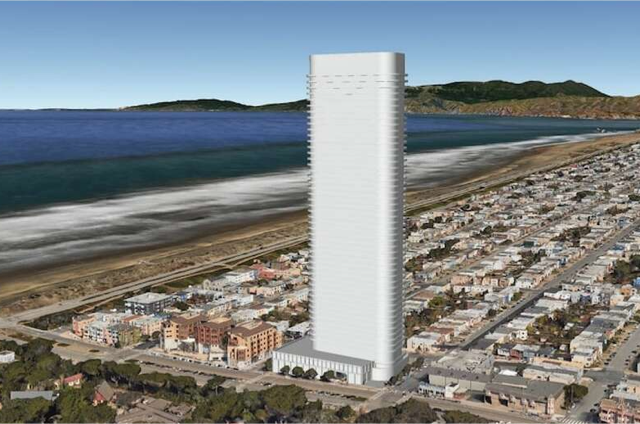
Matt Haney Seeks To Eliminate Only-in-San Francisco Appeals

By Thomas P. Tunny : reubenlaw – excerpt

Housing developers in San Francisco no doubt recognize this entitlement moment of disbelief: after a grueling, years-long process of working with staff, neighbors, and policy-makers, with numerous concessions made to address the potential impacts of their proposed project, the project finally receives its entitlement from the Planning Commission (a recent study found that a multifamily housing project takes 627 days on average to obtain a building permit) when lo and behold, the Board of Appeals sends notice that the project’s site permit has been appealed; and/or the demolition permit is appealed; and/or the grading permit; and/or the tree planting permit…(more)

This comment was sent from a resident in Southern California:
I heard them discussing a bill on KCBS this morning that the governor is trying to use to build a high rise Residential in San Francisco by over-riding the Board of Supervisors. Is this the Mr. Haney bill, AB 1114, Introduced? If it is and the way KCBS was describing how the governor was planning on using it in San Francisco , it was really frightening and threatening…

My response is that California is not looking good to the rest of the country. The national press is not very sympathetic to some of the more radical ideas that target communities and single projects coming out of the state legislature. It appears the Biz Journal ran a story on this. Article attached: AB 1114- Sloat

Can You Fight Bureaucracy With Bureaucracy? This New Commission is Optimistic

by David Sjostedt : sfstandard : excerpt

Members of a new committee overseeing SF’s Department of Homelessness and Supportive Housing are optimistic that their recently formed watchdog panel will cut through red tape and ultimately speed up City Hall’s response to the crisis unfolding on the streets of San Francisco.

The seven-member Homeless Oversight Commission, approved by voters last November, was initially criticized by Mayor London Breed for introducing yet another layer of bureaucracy to the city’s cumbersome homelessness response.

But some members of the newly formed oversight body—which is scheduled to meet for the first time in May—told The Standard that they hope to reduce the obstacles the homelessness department faces in quickly moving people off the street.

“What we don’t need is another grenade landing in everyone’s lap,” said former president of the Small Business Commission Sharky Laguana. “I don’t want to tie everybody up in a lot of long meetings, and I don’t want to go on a lot of wild goose chases.”…(more)

Looking forward to seeing who else is on the commissin. We hope they are able to clear up the mystery of where the money is going and set up a new system that replace the current DAHLIA that has failed to fill the emtpy spots for years. Where are those empty units and why are they so hard to fill?

State Won’t Cut Homelessness Funding—but Demands Results

By Sarah Wright : sfstandard – excerpt

Despite a massive budget deficit, California won’t cut funding for homelessness programs but sent a clear message to cities like San Francisco: Use it wisely, or else.

“People are dying in the streets in the name of compassion,” Gov. Gavin Newsom said at a press conference on Tuesday morning, a statement echoed by his Deputy Chief of Staff Jason Elliott later in the afternoon.

“At some point, the money can no longer be an excuse for inaction,” Elliott said. “We need to muster the political courage to match that investment.”

On Tuesday, the governor came through with his promise to keep funding the Homeless Housing, Assistance and Prevention Program, adding $1 billion to the pot after pausing funding late last year as a warning to cities to get serious about getting more people off the streets and into more permanent housing.

But the state doesn’t currently have the tools to do much more enforcement than that…

Though homelessness funding will remain intact, the governor announced $350 million in cuts to housing. Those cuts affect three homeownership programs that provide grants and loans to low- and moderate-income first-time homebuyers and support the production of Accessory Dwelling Units… (more)

Marc Benioff Calls To ‘Restructure’ SF Downtown, Adding More Housing

By Kevin Truong : sfstandard – excerpt

The walk up to the Moscone Center on Day 1 of Dreamforce had a sentimental air, with winding registration lines of techies in Allbirds or t-shirts advertising their favorite enterprise software under Patagonia vests…

The 20th iteration of Dreamforce tried to create a feeling of a return, underscored by the keynote presentation theme of “The Great Reunion” delivered by Salesforce co-CEOs Marc Benioff and Bret Taylor. As usual, Benioff played a starring role in the day’s events and used the stage to tout his commitments to the city and its recovery.

“This needs to go well so we attract more business back to San Francisco. This will be a key way of reopening downtown, reopening these areas and giving everybody a big boost,” Benioff said in an interview. “We invested a lot in Moscone, and this is the first time Moscone’s really being used. Everything is open for the first time so let’s see if this can be a great convention city.”…

Benioff said that as he traveled the country and observed the economic recovery in major business centers, San Francisco’s downtown stood out for its overwhelming reliance on office space…

“If you go to a city like Philadelphia it looks like it’s a lot more open. Why is that? Because you have office, residential, university, arts, all these things mixed in the downtown,” Benioff said, calling for “a lot more housing” in San Francisco’s downtown. “You have to rebalance, restructure, refill your downtown if you want it to feel alive.”…

And return-to-office mandates are not on the horizon: Benioff said recently at an event in New York City that “office mandates are never going to work.” …(more)

RELATED

Benioff Speaks  about a number of subjects during Dreamforce week.

Being as he is one of the only tech titans standing who holds much sway in San Francisco since the out of office exit turned the downtown into a deserted nightmare of streets and sidewalks with a threat on every corner, he is one of the few people who may be able to knock some sense into City Hall. We will share a few pearls of wisdom that he handed out from a number of media sources.

““There’s no finish line when it comes to security and social engineering,” He was commenting on Uber hack and the social engineering is puzzling but, perhaps it lack context.

“Salesforce CEO Marc Benioff on quiet quitting: Do what makes you happy”

Benioff Says San Francisco homelessness is improving as City’s performance scorecard shows 3.5% decline. He backed Prop C to fund homeless projects by taxing gross receipts on corporate revenue above $50 million.

The market ‘doesn’t fully appreciate how committed we are to growth and margins’, which means acquisitions of other tech companies are on the horizon.

Marc is inspired by Patagonia founder’s giving away his company. will he do something similar?

Mid-Sunset Letter on PCE contamination

Dear Neighbor,

So much has happened in our community these last few weeks. I want to summarize some significant events and suggest ways you can help create constructive change.

We had a very successful Community Meeting last week.  One hundred neighbors gathered to learn from experts what PCE is, where it has been found in the immediate neighborhood, what the Department of Toxicology and Substance Control (DTSC) is and is not doing to protect the neighbors, and what actions the community should demand in order to ensure protection for current residents as well as future residents in the area.  Our website has more extensive information on these questions….(MidSunst PCE letter and request for support)

Interim Zoning Controls – Parcel Delivery Service Uses

Thanks to the SF South East Alliance  and Supervisor Walton
for this city-wide ordinance to that puts an 18th month pause
of he expansion of Parcel Delivery Service  Users
Case Number:   2022-002847PCA
Board File/Enactment #:   220159
Initiated by:  Supervisor Walton
Effective Date:  April 1, 2022

The interim controls require Parcel Delivery Service uses to obtain Conditional Use authorization and set additional limits for Temporary Use authorizations of Parcel Delivery Service uses.

Background: Parcel Delivery Services are defined in Planning Code Sec. 102 as: A Non-Retail Automotive Use limited to facilities for the unloading, sorting, and reloading of local retail merchandise for deliveries, including but not limited to cannabis and cannabis products, where the operation is conducted entirely within a completely enclosed building, including garage facilities for local delivery trucks, but excluding repair shop facilities. Where permitted in PDR Districts, this use is not required to be operated within a completely enclosed building.

THE WAY IT WAS: THE WAY IT IS NOW:
Parcel Delivery Service uses were either Principally or Conditionally permitted in most M (Manufacturing), PDR (Production, Distribution, and Repair), MU (Mixed-Use), and C (Commercial) districts. Any new Parcel Delivery Service use must obtain Conditional Use authorization in districts where the Use was previously Principally permitted.
Parcel Delivery Service uses were not eligible for most Temporary Use authorization permits, except for the Temporary Use authorization for Interim Activities on Development Sites permit in Planning Code Sec. 205.5. Parcel Delivery Service uses may receive Temporary Use authorization in any zoning district for a period not to exceed 60 days within a 12-month period, without the possibility of renewal or subsequent approval during the same 12-month period. Parcel Delivery Services shall not be eligible for any other Temporary Use authorization permit.

These controls will be in place for 18 months or until permanent controls are established, whichever is first.

Link to signed legislation: https://sfgov.legistar.com/View.ashx?M=F&ID=10534391&GUID=D3A42751-B929-4917-8C2F-6BA77259F941

SF South East Alliance should be credited for taking this on and making it a city-wide ordiannce.  https://www.sfsea.org/moratorium

‘It looks like the Wild West’: Industrial dust is taking a toll on the Bayview

By Jessica Wolfrom : sfexaminer – excerpt

Candlestick Heights residents report health problems due to concrete crushing in vacant lots

The wind has always whipped up the earth at Candlestick Point, a waterfront expanse at the southeastern tip of San Francisco.

But last summer, Gayle Hart noticed a new kind of dust in the air. A brown film had settled over her neighborhood. It coated her car, crept into the corners of her patio and clogged her lungs.

Some days, the flurries were so bad that her 13-year-old son was unable to play basketball at the nearby playground. “He was only out there for about five minutes,” she said. “The dirt kept coming in his eyes.”…

Residents of Bayview’s Candlestick Heights neighborhood say the dust has been kicked up by concrete crushing and other industrial activity that recently has moved into the open parcels across the street from Hart’s townhouse on Arelious Walker Drive…(more)

Court upholds density bonus law

By Bob Egelko Court Reporter : sfchronicle – excerpt

Court upholds density bonus law that exempts certain housing projects from local restrictions

A state appeals court says developers who agree to include affordable housing in their projects can be exempted from zoning rules, height limits and other local restrictions on neighborhood construction. The ruling, in a case from San Diego, has potential statewide impact as tensions over local control and the state’s housing crisis continue to escalate.

California’s 1979 density bonus law “incentivizes the construction of affordable housing,” the Fourth District Court of Appeal said in a decision it certified Wednesday as a precedent for future cases.

Once the developer commits to making a specified portion of the project affordable to lower-income households, “local government must allow increased building density, grant permits, and waive any conflicting local development standards unless certain limited exceptions apply,” Justice Judith Haller said in the 3-0 ruling.

Those exceptions include threats to public health or safety, harm to a historic resource, or conflicts with state or federal laws. None applied to the proposed 20-story project overlooking Balboa Park in San Diego, so it can be built despite opposition from some community organizations, Haller said.

The court had first issued the ruling Jan. 7 as a decision that applied only to the San Diego project, but agreed to make it a published precedent after hearing from the California Building Industry Association and its Bay Area affiliate, as well as the project contractor…

Continue reading “Court upholds density bonus law”

Are ADU’s affordable housing?

The NYTimes says yes—but even the Chron agrees that the data shows these units are not a very effective way to address the housing crisis.

The California growth machine rarely breaks ranks. As a rule, its members toe the supply-side line: To solve the state’s housing affordability crisis, build everything except single-family homes—the more the better, because according to the “laws” of supply and demand, increasing supply lowers prices.

One of the machine’s favored housing types is the accessory dwelling unit, also known as an ADU, plannerese for granny flat. The state of California allows a city to count ADUs toward fulfilling its Regional Housing Needs Allocation, “based on the actual or anticipated affordability.”…(more)

Dom-i-city : Solving San Francisco’s housing problem

Eugene Lew presented his dom-i-city design concept to the CSFN General Assembly meeting Wednesday, January 18, 2022. This time he brought Cory Smith from SFHac to emphasize he fact that he has done the work of convincing a wide range of people that his ideas work. Together they presented a plan to enlist more people in adopting the dom-i-city plan in the West Side of town in a more gentle, humane manner that leads to a smaller footprint on the neighborhood, cuts cost, and meeting the approval of both city planners and the neighbors.