The State’s unrealistic, dysfunctional housing regulations demand that cities and counties “build” more housing, even though 98% of California’s cities and counties don’t build any housing: never have/never will. But, for all the anti-NIMBY, gavel pounding, and stomping of feet the state’s “trickle-down-the market will solve everything” approach has been an utter failure.
Let me repeat that. The state’s approach to increasing affordable housing has been an utter failure.
New ideas have been suggested but the state continues to double down on failure. A day of reckoning is approaching.
Over the past 15 years that the state has added regulations on top of regulations, penalties on top of penalties, and even resorted to having a special task force suing municipalities for Regional Housing Needs Allocation (RHNA) compliance, California housing production today (about 1 new house for every 656 people with a population of 39.4 million) is worse, on a per capita basis, than it was when all this started with the passage of SB 375 in 2008 (about 1 new home built for every 610 people in 2008 with a population of 36.3 million). And it’s a lot less than we were building 40 years ago (about 1 new home per 265 people with a population 23.8 million).
In other words, we’re building less housing today than 40 years ago…(more)
This week, the Board of Supervisors has a return engagement with two controversial housing bills, and is set to clear financing for three importantaffordable housing projects. They will also likely vote to expand a funding scheme for further promoting tourism, and declare certification of theJune 7 election results. (As always, wonks looking for the full kit and caboodle can check out the complete agenda.)
Housing Bills: Will Gridlock Continue?
The Board is set to again consider two bills on housing that caused considerable headaches for housing advocates: one, to legalize more dwelling units in single-family neighborhoods, and another to stop development of certain “micro-unit” housing projects. The two bills have been paired together as part of a compromise, but at the board’s June 14 meeting,District 8 SupervisorRafael Mandelman asked that the bills be continued due to advice from the City Attorney.
The Mandelman bill, originally drafted to allow some fourplexes and other multi-unit buildings in districts zoned for single-family homes, was received with some optimism from housing advocates. But it was plunged into development hell at the board’s Land Use and Transportation Committee, who tacked on several caveats…
The companion bill, sponsored by District 3 SupervisorAaron Peskin, bans “micro-unit” efficiency studio housing in the Tenderloin and Chinatown, with the intention of preventing the gentrification of those neighborhoods’ existing stock of single room occupancy hotels…(more)
They might as well quit building micro units since most are empty due to the lack of takers.
It appears that the majority of public EV chargers were all planned for the now empty downtown office buildings and hotels and for some reason there are a lot of them around North Beach and Fisherman’s Wharf.
Another mistaken assumption by our city planners that the office workers would drive EVs and the rest of us would not. What do you want to bet that the EV chargers are not cheap. Perhaps they would like to move them to less dense neighborhoods where car owners live and now work in larger numbers.
It’s a rare election in San Francisco that doesn’t feature some form of measure on the ballot, and some of the policy questions they pose might have you asking how they wound up going to voters in the first place…
So far, San Francisco has voted on 11 ballot questions, including four recalls. Our final election of the year, on Nov. 8, will probably also feature a full slate of measures. To date, the Board of Supervisors is mulling 10 more charter amendments for the fall election. Meanwhile, more measures—including a plan to undo car closures in Golden Gate Park and the Great Highway—are in the works.
So, how do these questions come before the electorate?
Ballot measures can land on the ballot in multiple ways, from signature-gathering to the legislative process. Here’s a breakdown of the different kinds of ballot measures and how exactly they happen…(more)
Thanks to the author for taking this on. We need a refresher course every now and then since the laws on these procedures have been known to change.
The struggle over homeless services in The Haight will continue.
A new law will require The City to locate 20 units of temporary housing for young adults facing homelessness in the neighborhood — but it seems unlikely to ever actually happen.
Mayor London Breed will decline to sign the law, to which the Board of Supervisors gave final approval this month, her office confirmed to The Examiner. Nevertheless, the law will still take effect. It passed with unanimous support from the Board of Supervisors, rendering Breed’s veto power meaningless. Still, her refusal to sign is a signal she does not support the bill…
The Department of Homelessness and Supportive Housing reviewed Preston’s legislation in a May report and estimated that it would cost between $5.7 million to $9 million to purchase 20 new units of housing. The cost of actually operating a 20-bed shelter was estimated to be between $715,000 to $860,000 per year.
The City has $58.4 million left in its Our City, Our home fund earmarked for transition-age-youth housing, but spending it on shelter — including the transitional shelter stipulated in Preston’s legislation — is not allowed without a tweak to city law, according to HSH.
The City’s Real Estate Division looked in the neighborhood and did not find a single appropriate building for sale. Eleven were available for lease, but none of those were an entire building…(more)
There are two major downsides to capitalism. One, in capitalism there are winners and there are losers. And two, the end product of capitalism is an unlivable planet.
So their marketing wizards came up with a campaign that argued that lower income Californians who could not afford rooftop solar were subsidizing the rooftop solar of those who could – and who got rebates for returning energy to the grid. Gonzalez sponsored AB 1139, a bill that would have decreased the amount that people with rooftop solar would be paid for the energy they pump into the grid and increased the amount they would have been charged for monthly grid maintenance.(See analysis of donations to state lawmakers at the end of this story.).
But the idea hasn’t gone away. It’s just been moved to the five, unelected members of the California Public Utilities Commission...
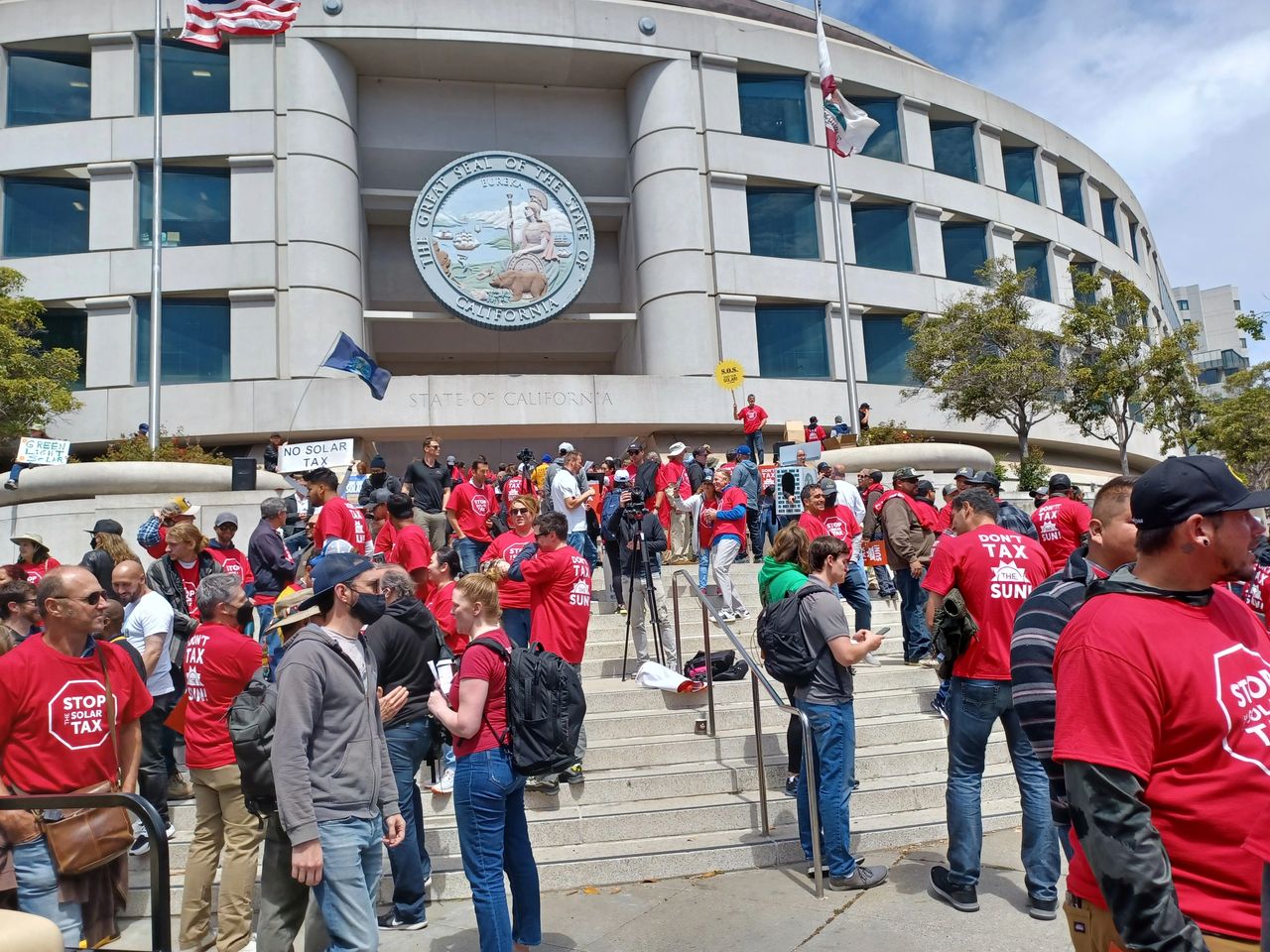
On Thursday, June 2, hundreds of rooftop solar installers, rooftop solar customers, environmentalists, and representatives of disadvantaged communities rallied at the CPUC buildings in San Francisco and Los Angeles to protest the newest proposals. The essence of their opposition? Reducing net metering rates (the rebates that go back to entities that pump electricity into the grid from rooftop solar) and raising grid maintenance rates would enrich these utilities at the expense of the planet. Crucially, these proposals would eliminate the financial incentives that homeowners now have to install rooftop solar. Opponents have called the proposals a tax on the sun. They also would have put about 2,000 solar companies out of business and eliminated around 70,000 jobs, according to the California Solar & Storage Association...(more)
Read the rest of the articles linked above for more details on the various players so you will know where to push the matter at the state level. Phil Ting supported AB1139. Call him to let him know where you stand and how likely you are to oppose his next run for office if he continues to support Big Energy companies efforts to kill solar.
In our case, we should also call and send letters to Senator Wiener and Assemblymembers Ting and Haney and any oher people in Sacramento you know. Phone calls to the CPUC directors are also encouraged. See some contact info here: https://discoveryink.wordpress.com/ca-legislative-process
an Francisco’s police union has turned against its president, pressuring him to resign as rumors of financial impropriety upended his attempt to return to his leadership role from extended medical leave.
Tony Montoya has stepped down as president of the San Francisco Police Officers Association, his successor Tracy McCray announced Wednesday in an internal email to officers obtained by The Standard.
Montoya’s departure represents a changing of the guard in a union that tried to rehabilitate its relationship with City Hall under his tenure. Montoya was by no means a champion of reform, but he struck a more conciliatory tone than his predecessors whose vocal criticism earned them a reputation for undermining change…(more)
Boudin Ousted by Coalition of Asian Voters From All Income Levels and Wealthy Whites
By Anna Tong : sfstandard – excerpt
A powerful bloc of voters led by Asians and affluent white residents drove support for Tuesday’s recall of District Attorney Chesa Boudin, according to election day results by voting precinct. The anti-recall campaign, by contrast, failed to make inroads beyond the city’s progressive strongholds.
The latest data available shows Proposition H, the ballot measure, passing by about 60-40 citywide. That’s a clear majority, but support was hardly uniform across SF. Neighborhoods where support for the recall exceeded 80% included precincts in the Marina, Visitacion Valley and around Lake Merced. Put together, it tells a story of a recall support coalition between affluent, whiter neighborhoods and Asians from across the economic spectrum.…(more)
The question to answer is “why are people in some districts not voting?” or is it the mail-in votes on the last day that cause the delay and create the illusion that people are not voting?

 Assembly Districts areas shifted. Find out which you are in now.